

Putnam County Stone, LLC
We are dedicated to providing the necessary materials to fix crumbling infrastructure, ensure safe roads and maintain low taxes for Putnam County residents.
Learn MoreAbout
Providing Construction Materials. Creating Jobs. Protecting the Environment.
This quarry isn’t just a valuable natural resource to Putnam County; it’s a cornerstone of our community’s progress. Aggregates from this site will help build the roads we drive on, the schools where our children learn, the hospitals that care for us and the beautiful homes we cherish. Together, we’re laying the foundation for a stronger, more connected future.
This quarry is a partnership with Putnam County. By creating 211 construction jobs and 88 permanent positions, it will fuel local careers and livelihoods. With $6.7 million in tax revenue and $90.3 million in total earnings for local workers, the economic ripple effect will uplift families, businesses and the entire region.
Progress and preservation go hand in hand. With careful planning and environmental stewardship, we’ll ensure the quarry operates in harmony with the surrounding landscape. Independent hydrogeologic studies confirm no adverse effects on nearby surface waters or private wells. Protective buffers safeguard the community, and we guarantee full protection for every property owner with a water well within 1 mile of the quarry. Plus, our water usage is sustainable, relying primarily on rainwater collected in the quarry pit to minimize external impact.
Our commitment to the county doesn’t end when operations do—it’s just the beginning. Through a comprehensive reclamation process, we transform quarry sites into vibrant community assets. Picture thriving wildlife habitats, serene water reservoirs and inviting public spaces that celebrate the natural beauty of our region. Together, we’re preserving the spirit of Putnam County for generations to come.
SEE HOW ROCK QUARRIES ARE THE HIDDEN ENGINES OF GROWTH IN A COMMUNITY.
Read About Rock Quarries Here
FAQ
A Quarry in Putnam County
Aggregates like sand, gravel and crushed stone (granite) are the United States’ top natural resources by volume – and our proposed quarry pit site in Putnam County has been abundantly blessed with granite.
That’s important, because the closer an aggregate supply (the quarry) is to where it’s in demand (for infrastructure, like roads), the more affordable that natural resource becomes. It’s a simple matter of distance and shipping costs. Aggregates are usually delivered by trucks, meaning that the transportation costs rise significantly per additional mile and those additional costs are passed on to the end customer. A quarry in Putnam County means shorter haul distances with less fuel used and therefore lower overall costs for projects in the county and fewer trucks on the road when compared with hauling from further away.
Underneath a portion of the Putnam County land owned by Weyerhaeuser, a quality timberland company with which to do business, there is about 35 million tons of granite stone material available for mining and aggregate production. Putnam County Stone LLC will excavate this natural resource safely and responsibly from a 61-acre pit to be used in the county and neighboring areas to build and maintain the vital infrastructure we all use every day. The reduced construction costs from having this quarry benefit all of Putnam County and its residents.
The aggregates mined and produced at the quarry are essential for our modern lifestyle and almost every large and small construction project in the county. From the homes we live in, the roads and bridges we drive on, the offices we drive to, the schools our kids attend, and the hospitals that heal us – they rely on aggregate throughout all phases of construction and maintenance.
How important is aggregate? The next time you’re on a highway, consider that it requires 38,000 tons of aggregate to construct just one mile of four-lane road.
If you measure the distances from the next closest quarry to Eatonton, the difference in haul times from Putnam County Stone LLC’s proposed location to the city compared with that next closest quarry leads to a 50-minute savings per round trip.
At an average rate of $120 an hour for a dump truck carrying an average of 18 tons, it results in a savings of about $5.55 per ton for every ton that would come out of Putnam County Stone. With estimated sales of about 500,000 tons every year, that would yield nearly $2.8 million in annual savings for the county. These savings are from reduced truck miles, which means additional savings in reduced wear and tear on county road.
These savings accrue to a variety of purchasers, including the county itself, contractors who build and maintain infrastructure, and direct purchasers. These savings then get passed along in the form of lower mortgage payments, leases and taxes to the county.
Putnam County Stone Quarry Operations
Aggregate is quarried from ground deposits that formed over a long period of time. When a quarry is started, several feet of “overburden” are removed to access the rock base. This overburden is then used to create tall and thick berms around the quarry to mitigate sound and sightlines.
Once the overburden is removed, the rock base is then loosened or broken into smaller pieces using modern blasting techniques, then taken to machines on-site that crush the rock into various sizes. The crushed stone is then sent to nearby markets.
When people hear the word “blasting,” they often incorrectly imagine random, unpredictable explosions using sticks of dynamite – think brute force. But modern blasting is scientific, controlled and safe – think precision engineering.
In the past, quarries used dynamite placed in holes drilled into rock in spaces selected by rule-of-thumb distance estimations instead of scientific calculations. Explosions relied upon fuses that could misfire or burn unpredictably and produced uneven rock fragmentation. Workers had to be close to the blast area, so rock thrown by blasts or accidental detonations were common hazards. Blasts were often one big shot instead of carefully staged sequences, while workers had little understanding of rock mechanics and stress distribution. These old blasting methods produced high levels of dust, vibration and noise with no mitigation.
Blasting is much different today. Putnam County Stone LLC applies modern blasting techniques rooted in science, precision and safety. Instead of dynamite sticks, quarry workers use modern industrial emulsion explosives, which are more stable and customizable. Explosives are tailored to rock type and desired fragmentation. GPS-guided drilling rigs create accurate bore hole patterns, and engineers use software to model rock density, fracture lines and blast energy distribution. Fuses have been replaced with electronic detonators that fire in millisecond delays to create controlled, staged blasts instead of a single blast. Controlled blasts are designed to produce stones in specific sizes to improve efficiency and lower costs. Remote detonation systems keep workers at safe distances, real-time blast monitoring detects misfires and anomalies, and state regulations and monitoring systems are always in place. Controlled timing reduces vibration, while suppressions systems mitigate dust.
Blasts at the Putnam County quarry will last less than 1 second. We will enable neighboring property owners, at their request, to be contacted in advance of these 1-second blasts, which would occur only two or three times a month and be limited to between 10 a.m. - 4 p.m., weekdays only – never on weekends or holidays.
For more details about blasting, dust and vibration, visit the “Addressing Residents’ Concerns” section below.
The quarry will produce construction-grade aggregates that are mixed with cement to form concrete or with hot “bitumen” to create asphalt. By composition, both concrete and asphalt are 80% aggregate. In other words, almost everyone reading this has aggregate in their driveway – either as crushed stone without cement and asphalt mixed in (or as part of concrete and asphalt cover).
Aggregate is also used in road construction as “base” to support vehicle weight and as asphalt cover, which all of us use when we travel. Commercial buildings, schools, hospitals and offices with walls and floors made of concrete also require aggregate.
Putnam County Stone Quarry Benefits
There are four immediate benefits of this quarry:
- First, more affordable construction for local residents: Putnam County Stone will enable more affordable construction by adding a robust and secure supply of local construction-grade aggregate. That means more affordable homes and hospitals, but also more affordable schools, bridges and roadways. Local rock means reduced costs for builders and their projects.
- Second, good jobs: Construction and development of the quarry will support 211 jobs in Putnam County with total labor compensation of $10 million, which includes jobs in the construction sector and associated labor compensation. These 211 jobs will be temporary, lasting about one year. Once the quarry opens, it will at first create 15 permanent jobs with estimated labor income of $1.2 million, plus 35 jobs in contract trucking and 38 at other county businesses. In addition to direct employment opportunities, the quarry will contract with local vendors and support local small businesses.
- Third, creation of rip-rap: Rip-rap is a protective layer of large, loose stones placed around shorelines to prevent soil erosion. Since Lake Sinclair and Lake Oconee are both man-made (artificial), rip-rap is vital to protect their shorelines and fish habitat while absorbing waves. A quarry in Putnam County means a bountiful and more affordable local supply of rip-rap for the lakes.
- Fourth, taxes: The quarry is a substantial investment that would mean an increase in the county tax base due to the annual property tax revenue it will pay, a large amount of sales tax revenues from the sale of aggregate products in Georgia produced at this facility, and new housing for those employed and new businesses to serve them. These estimated $489,000 to $612,000 in new tax revenues can be used to fund a number of different activities and causes that benefit the entire community, such as schools and first responders. Georgia Southern University Economics Prof. Dr. Michael Toma’s study of the project predicts the quarry will generate between $9.8 million and $12.2 million in tax revenue for the county and $80 million in earnings and fringe benefits in the first 20 years.
Bottom Line: Putnam County Stone will turn an essential local resource into an economic engine, keeping good jobs and tax dollars in the local area. That creates a better quality of life for the entire community.
Addressing Residents’ Concerns
Putnam County Stone LLC hired respected engineering design firm TTL Inc. to analyze the quarry’s traffic impact. This study was published in full as part of our rezoning application with Putnam County and is therefore public record.
TTL found activities at Putnam County Stone’s quarry would have no material impacts on traffic or traffic conditions, noting the current level of service and operational performance of the roads bordering the quarry site don’t require any improvements to maintain current overall operational performance. It also shows the quarry’s daily activities will result in only a modest number of additional vehicular trips, predominately trucks:
- Dennis Station Road’s capacity would increase only 1.4 points from 8.9% today to 10.3% with the quarry.
- Milledgeville Road’s capacity would increase only 1.4 points from 8.1% today to 9.5% with the quarry.
- US 441’s capacity would increase only 0.7 points from 34.2% today to 34.9% with the quarry.
The study further notes the end result still maintains excellent operations at all key locations without needing any additional improvements. These key locations include the Dennis Station Road and Milledgeville Road intersection, the Milledgeville Road and U.S. 441 intersection, the Dennis Station Road and Twin Bridges Road intersection, the Twin Bridges Road and U.S. 441 intersection, and the Dennis Station Road and facility entrance intersection.
Having a local quarry will lower costs and mean far fewer miles put on county roads by trucks. And while traffic would increase on Dennis Station Road, that road will be upgraded in spring/summer 2026 to support 100,000-pound trucks and can sustainably support those trucks’ weight, so wear and tear will not be an issue.
Nevertheless, we have proposed paying to add an 800-foot acceleration lane for our trucks entering northbound on Dennis Station Road to alleviate traffic and safety concerns. Trucks will not park or stage on Dennis Station Road. Shipping operations at the quarry would at most mean 160 trips per day – at peak capacity, that’s about 13 trips per hour during daily operations. Our exit onto Dennis Station Road will force trucks to turn right only heading north.
Additionally, a tire wash will be installed for outbound trucks to remove sediment materials before they exit onto Dennis Station Road to prevent track out and dust.
We have a history of safe quarry operations with responsible environmental stewardship – a reputation of which we’re immensely proud.
For the Putnam County quarry permit, we hired one of the best hydrogeologic companies in Georgia, Bunnell Lammons Engineering, to perform an assessment of the site’s geology and hydrogeology, as we do for all quarry projects.
It found:
“Mining activities, including dewatering of the mining pit when necessary, are not expected to have any direct adverse influence to flow volumes in on-site and nearby surface waters in the project area. The predicted effects of groundwater drawdown on or within the vicinity of the project site will not cause adverse impacts to groundwater levels in the vicinity of surface water tributaries to Lake Sinclair or to flow volumes in those tributaries, and it will not have adverse impacts to water levels in Lake Sinclair.”
In fact, the entire property to be rezoned is outside of the 2-mile lake buffers for both Lake Sinclair and Lake Oconee.
WellsImportantly, the hydrogeologic study also
“demonstrates that mining activities in the geologic and hydrogeologic formation under the project site will not anticipate adverse effects on private drinking water wells in the vicinity.”
The study confirmed there are no registered or known public water supply wells or springs, or surface water intakes identified within 2 miles of the quarry site.
It further noted:
“The majority of the confirmed or suspected private drinking wells in the area are located northwest of the proposed quarry pit and therefore are not anticipated to experience significant fluctuations in groundwater elevations due to mine dewatering.”
Still, we understand concerns about how our new quarry operation could affect your water well. That’s why we’ll install monitoring wells on the property and maintain these monitoring wells throughout the life of the quarry’s operations.
We also have a Quarry Neighbor Water Well Policy to ensure you continue to have a safe and reliable water supply. If you own a water well within 1 mile of our active quarry pit, you are covered by this policy. And if you experience a noticeable drop in your well’s water level or flow that affects your normal daily household activities, notify us – simply call or email Putnam County Stone LLC right away.
We promise to act quickly and transparently. That means:
- 1. Fast investigation: Within two business days of your call or email, PCS will hire a licensed Georgia well specialist of your choosing to come to your property. This specialist will examine your well to determine the cause of the problem and measure the water level.
- 2. Quick determination: The specialist will provide their finding on the cause of the well failure within seven days of being contacted.
- 3. If the problem is not from the quarry: We will let you know immediately. In this case, you will be responsible for the repairs.
- 4. If the problem is from the quarry: If the specialist determines the well failed due to a decline in water level or flow caused directly by our mining or dewatering activities, we will pay 100% of the cost to provide you with a permanent, fully functioning water supply at the same amount of water you used before the problem occurred. We will act as fast as possible, and you get to choose the best option available for your home from the following:
- Fixing, repairing or deepening your current well.
- Drilling and installing a brand-new well of the same or larger size and connecting it to your home's plumbing.
We also know you need water immediately. So, if we caused the problem and a permanent fix will take longer than three business days after the cause is determined, PCS will deliver a temporary supply of clean, drinkable water (such as a tanker or container) for all household needs (drinking, bathing, washing) within one business day. We will pay for all the costs, including refills.
If your well fails, you do not have to wait for the determination. You may obtain your own temporary potable water supply for household use. If we later determine the quarry caused the failure, we will fully reimburse you for the cost of the temporary supply upon seeing your receipts.
SedimentationPutnam County Stone’s operations will strictly obey all state and federal laws that regulate the industry to ensure protection of the surrounding environment, including all state waters. That means we will adhere to the Georgia Environmental Protection Division-approved Surface Mining Land Use Plan that contains an Erosion and Sedimentation Control Plan.
We will control erosion and sedimentation using best practices that comply with the standards outlined in the Georgia Soil and Water Conservation Commission’s “Georgia Manual for Erosion and Sediment Control.” This includes, but is not limited to, perimeter controls, silt barriers, brush barriers, construction exits, temporary seeding, permanent seeding, mulching, surface roughening, diversion berms, excelsior matting, sediment basins, check dams and lined stormwater conveyances. Diversion berms and ditches can be used to direct stormwater runoff into basins or the mine pit to prevent sediment from leaving the facility. Additionally, berms can be used to divert run-on stormwater around disturbed areas.
The Putnam County quarry will have buffer zones and settling ponds to protect water quality, reduce sedimentation, and maintain soil health and stability. We will feature a minimum buffer of 200 feet along and within its property lines and 100-foot buffers around perennial streams. Notably, this goes beyond the state-required 50-foot buffer on state waters.
StormwaterStormwater runoff will be managed using diversion swales, silt fencing and other standard best management practices. As Georgia requires, state-approved erosion and sedimentation control plans will be prepared and implemented to prevent pollution associated with runoff from the site. A portion of the stormwater has been designed to drain back into the quarry pit area. Excess stormwater will be channeled/diverted to sediment control basins.
Following diversion to the proposed sediment basins, any water discharged from the site will be routed through a state-approved discharge point and is required to meet strict quality and cleanliness standards before any water is allowed to leave the site.
It’s also important to note that because of the pit capturing water, the vegetation we’ll plant and the sediment basins themselves, quarries actually generate less sediment than many agricultural activities.
Water usageOur operations are self-contained and have no measurable effect on water levels in the nearby streams or lake. There will be a well to supply the office building on-site. Beyond that, most of the water the quarry needs is pumped from the quarry itself, which collects rainwater in ponds. Water is pumped from these ponds and used to mitigate dust and rinse the rock.
State and federal laws make it illegal to create uncontrolled or excessive dust, and we simply don’t violate these environmental, safety and air quality regulations. In fact, getting approval and retaining our state and federal permits demands we control dust.
Typical dust control measures that will be required in the Georgia EPD Air Permit include dust suppression sprayers along conveyors and at crushers, water to rinse rock at load outs, water trucks that spray directly onto access roads and travel ways, sprinkler systems used for stockpiles, and/or wheel wash stations, as necessary.
Dust can also be minimized through timely stabilization of disturbed areas with mulch, temporary seeding or permanent seeding. Wheel wash stations at site exits will remove mud and dust to prevent tracking onto public roads, and trucks transporting materials are often required to be covered with tarps. Crushers and screens are similarly enclosed, sometimes coupled with suction hoods to capture dust. Dust collection systems are used to pull dusty air from processing machines, filter it and release clean air.
Air quality will be continuously monitored and managed.
Furthermore, we have a legal and moral duty to keep our employees safe from any potential health effects from dust. These employees work just a few feet from our machines. We demonstrate every day that we keep our employees safe, which means our neighbors thousands of feet away from the quarry will also be safe.
As we do for all projects, we tapped sound experts to analyze the Putnam County quarry site to predict potential noise impacts. This sound study by Sauls Seismic LLC – published in full as part of our rezoning application with Putnam County – analyzed comparable quarry operations.
It concluded:
“The impact of quarry and production plant operations on existing background sound levels at adjacent properties will be, at most, minimal in nature, and within applicable noise standards and typical sound levels for comparable residential, commercial and industrial property uses in the vicinity… Putnam County Stone will maintain sound levels at or below 70 dBA Leq measured at the property line.”
To put that noise level into perspective, 70 dBA (decibels) is equivalent to the sound of normal office background noise.
Furthermore, the Putnam County quarry’s earthen berms and setbacks will largely obscure the sights and sounds of our operations while preserving the area’s rural character. We will maintain a 200-foot undisturbed buffer around the entire mine property and all extraction and processing activities will be conducted at more than 1,000 feet from any residence or any property that is zoned residential. Additionally, we will build a 20-foot berm between the plant and processing area and the existing adjacent residential zoned properties to the north of the processing area to further reduce potential nuisance noise.
However, we must build the berms and vegetated buffers during the quarry project’s construction phase. This means trucks will dump the berm materials around the property line, temporarily creating some noise. But it will be a short-term discomfort to enjoy a long-term comfort.
Additionally, we use rubber liners on our heavy-duty equipment to protect the metal, reduce wear and dampen the sound when we process and dump rock.
After quarry operations begin, we’ll test sound levels and remain committed to never exceeding 70 dBA Leq at the property line. Should sound levels exceed that margin, we’ll build bigger berms, add sound-proof enclosures and/or add sound-barrier walls, if necessary. We stand by our commitment to maintain our neighbors’ comfort.
Our proposed quarry offers considerable site advantages with a plant pad placed strategically inside a naturally low area that will contain noise within the plant area.
Quarries mitigate blasting noise and ground vibration through precise blast design engineering, electronic timing systems and strategic environmental planning. As noted in the “Putnam County Stone Quarry Operations” section above, modern blasting techniques are scientific, controlled and safe.
It's important to know blasts last only 1 second or less. We use monitoring equipment, such as blasting seismographs to measure velocity in the ground and microphones to record air overpressure in decibels. All blasting will be performed in accordance with state and federal laws, the Putnam County Performance Standards for blasting, and the Georgia Safety Fire Commission Rules and Regulations for Explosives and Blasting Agents.
According to Putnam County Zoning Performance Standards, mining activities can only occur at a distance greater than 1,000 feet from any residence. Currently, the closest residential structure is approximately 2,445 feet away from the quarry’s pit boundary, which is expected to isolate it from seismic vibrations. And the Georgia Power substation is 2,240 feet away from the quarry’s pit boundary.
A sound study by Sauls Seismic LLC also confirms blast limits at the Putnam quarry will be “significantly lower than the recommended safe blast limits and Georgia’s regulatory limits.”
The typical quarry blasting activities will produce vibration levels less than 10% of the limit for high frequency vibrations and far below threshold damage levels.
We will enable neighboring property owners, at their request, to be contacted in advance of the less-than-1-second blasts, which would occur only two to three times a month and be limited to between 10 a.m. – 4 p.m., weekdays only – never on weekends or holidays.
Putnam County Stone hired Kirkland Appraisers LLC (Member of the Appraisal Institute) to conduct a property-value impact evaluation based on several comparable quarries currently operating in Georgia and other states and their impact on local property values. This study was published in full as part of our rezoning application with Putnam County and is therefore public record.
The study concluded:
“The proposed quarry, where located, as designed and as proposed to be operated, will be in unity and harmony with the surrounding area and will maintain the value of adjoining or adjacent property.”
It also found the quarry:
“…will not have a negative impact on the value of adjoining or adjacent residential, agricultural or other properties in proximity to the quarry given the proposed setbacks, berms, landscaping and buffers, including specific buffer distances from residential properties and specified public uses contained in the Putnam County Zoning Ordinance.”
While Weyerhaeuser’s tract on Dennis Station Road is a great place for a quarry, we are NOT asking the county to rezone the entire 917.8-acre tract.
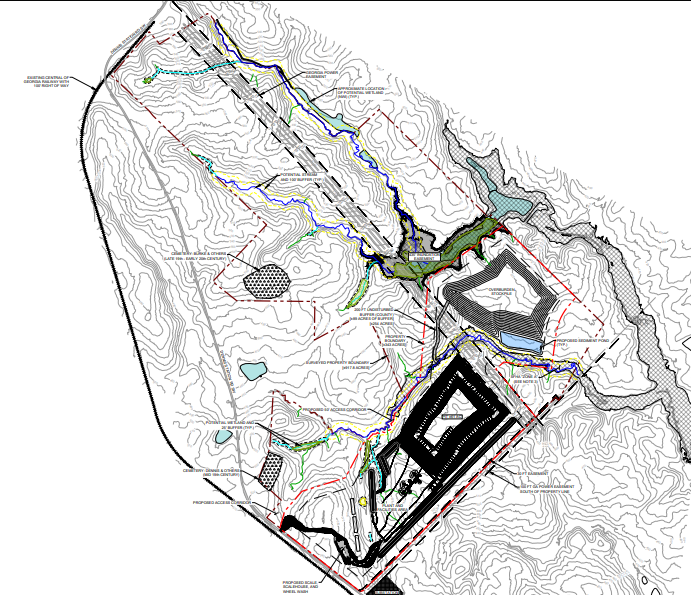
In our new, modified site plan, we’re requesting Industrial-Manufacturing rezoning for 343 acres, which includes 89 acres of undisturbed buffer. In other words, our quarry and its operations will be on 254 acres and only 61 of those acres will be the mining pit.
This site plan will limit the rezoning so that our operations can only function on the rezoned parcel, while the remaining land will retain its current agricultural zoning. Notably, the entire property we’ve asked to be rezoned is outside of the 2-mile lake buffers for both Lake Sinclair and Lake Oconee.
We hired Cranston Engineering to create a Land Use Compatibility Report, which was prepared by a professional civil engineer who is also a certified land planner. This report – part of the public record in our rezoning request – found the Putnam County quarry site is an “ideal location” for a new granite quarry and crushed stone production operation, “represents the highest and best use of the subject property,” and its “potential impacts to the surrounding properties will be neutral.”
Importantly, the report also says:- “The proposed project is consistent with the Vision of the Comprehensive Plan for ‘economic growth throughout the entire county.’ and the general Land Use Needs/Opportunities goals and policies; and fits the spirit, purpose and intent of the Comprehensive Plan.”
- “The proposed project on the tract to be rezoned will have a minimal effect or no effect on public services.”
- “The proposed use reflects a reasonable balance between the promotion of the public health, safety, and a reasonable private use of the subject property. From a land use planning perspective, the subject property is an ideal location for a new granite quarry and crushed stone production operation.”
Community
We work hard to listen to our neighbors, preserve the local quality of life and protect Putnam County’s environment that we all care about. The use of berms around the perimeter of the quarry will conceal its operations and maintain the picturesque beauty of the Putnam County countryside. Our operations place a great deal of emphasis on environmental protective features and high-tech monitoring to not only ensure a safe work environment for the employees, contractors and visitors inside the quarry, but also to protect the surrounding community.
We use modern dust control best practices like covers, enclosures, foggers, spray bars and foam applicators to capture dust on-site, minimizing any off site impacts. Strategically-placed monitoring wells are positioned around the perimeter of the quarry to ensure our operations do not negatively impact the water table or the home water wells of our neighbors.
Jobs
The best way to ensure a quarry operates responsibly is to hire local people to operate it—and that’s exactly what we plan to do. Putnam County Stone will support high-paying local jobs and contribute to the Putnam County tax base. Our quarry will need skilled maintenance personnel, welders, fabricators, electricians, millwrights and heavy equipment technicians—just to name a few. Jobs at our quarry will offer important health and retirement benefits that will support area families. As a source of tax revenue for the county, our operations will benefit local taxpayers by funding projects like roads and schools, which helps keep property taxes low. Just as importantly, local quarries—like Putnam County Stone—ensure a local supply of construction-grade aggregates, which makes homes more affordable for local homeowners and infrastructure more affordable for local taxpayers.
The Phoenix-Center study provides an in-depth analysis of the economic benefits a quarry brings to the community and can be viewed here.
Safe Working Environment
Putnam County Stone is committed to providing a safe work environment for our employees, vendors, contracted truck drivers, and anyone else visiting our site. We do work unceasingly to cultivate a culture of safety from the hourly workers to upper management with the belief that, “Safety is Everyone’s Responsibility.”
"*" indicates required fields